



















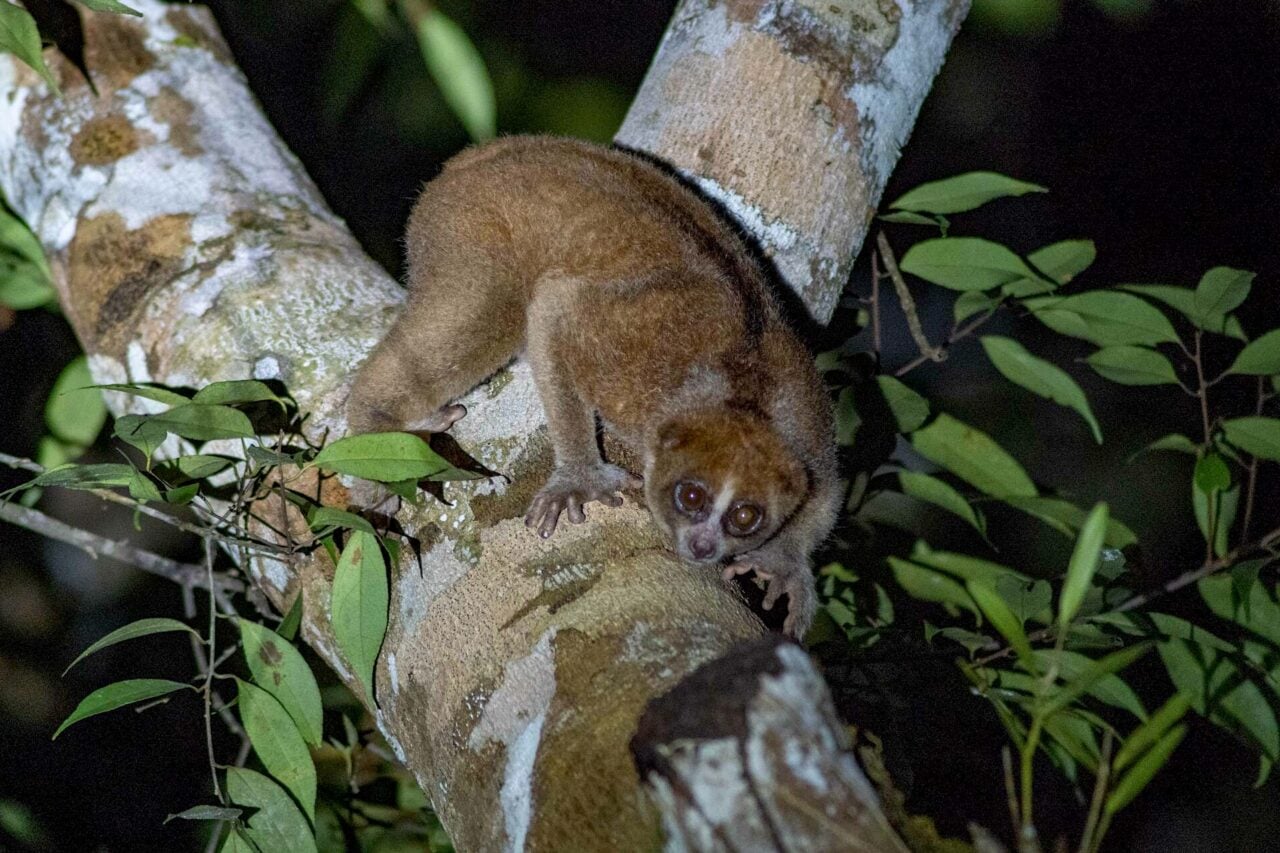
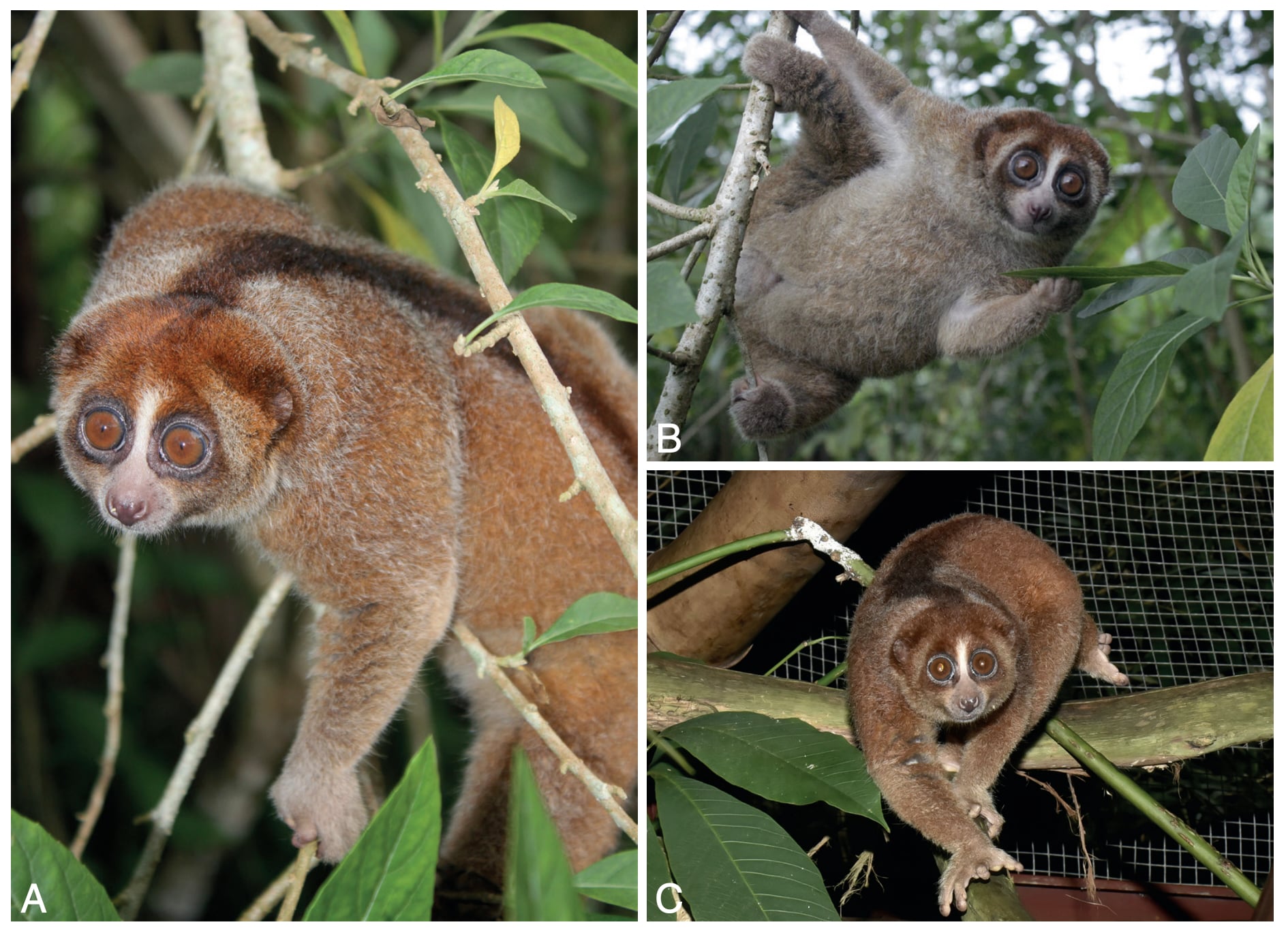
Tiny, nocturnal, and expert at remaining hidden, the Bangka slow loris (Nycticebus bancanus) has spent nearly a century evading wildlife biologists around its native habitats on the Indonesian islands of Bangka, Sumatra, and Borneo. Before it vanished in 1937, this big-eyed creature was a member of the world’s only known group of venomous primates—via a bizarre toxin activated when the loris licks a gland on the inside of its upper arm, making its bite more dangerous or its fur poisonous via a little bit of defensive grooming.
But conservationists have finally tracked down the Bangka slow loris, a case of “lost” taxon presumed extinct, thanks to a series of wildlife rescues performed by Indonesia’s Alobi Wildlife Rescue Center between 2015 and 2025. Indonesia is home to multiple species of slow loris, including Sunda (Nycticebus coucang) and Kayan River (Nycticebus kayan) varieties, which may explain how the Bangka slow loris managed to avoid a scientifically confirmed detection across this decade of contact with the rescue center.
As the researchers noted in their new study, published this October in the journal Spixiana, as many as potentially 90 Bangka slow loris specimens were “identified at the species level by the Alobi staff based on fur colouration and the circumstances of the discovery.”
“What I find particularly astonishing is that such a charismatic and distinctive primate has received so little scientific attention for nearly a century,” study coauthor and biodiversity researcher Timon Glaw told Reuters. “After all, Bangka is just about an hour flight from Jakarta, one of the largest cities in the world.”
Shocking cases
Reliable measurements place the Bangka slow loris on the smaller end of the range for genus Nycticebus. It’s known to grow up to 10 inches (25.8 centimeters) in length compared to the Sumatran slow loris (Nycticebus hilleri), for example, which can grow up to 15 inches (37 cm) long. That said, the Bangka is arguably the most lethal slow loris species given that its extremely unusual, saliva-activated, underarm-secreted venom is reportedly toxic enough to put a grown human into anaphylactic shock.
At least seven of the Bangka slow loris specimens that were rescued by Alobi’s volunteers and staff, however, had been shocked themselves—suffering burn injuries consistent with accidental contact while climbing electric power lines.
Tricky engagement with encroaching human-made environments appeared to be the primary connecting factor between the 39 of the 90 Bangka slow loris cases for which the rescue center had detailed records: According to the new study, 16 rescued specimens were discovered sneaking into houses and gardens. Six more were picked up stranded on the side of the road. Another “five individuals were rescued from the local wildlife trade or from captivity, three individuals were found in plantations, one individual was found entangled in a fence, and one individual was attacked by a dog.”
“Its natural habitat on Bangka Island has shrunk significantly because of illegal tin mining and massive land clearing for oil palm plantations,” as Langka Sani, the director of the Alobi Wildlife Rescue Center, noted in a statement. “We are glad to contribute to the scientific record to show that the Bangka slow loris is not lost, but the species is still very close to extinction.”
A slow decline
Despite the long presumption of extinction, the International Union for Conservation of Nature’s Red List status for the Bangka slow loris has conservatively remained “critically endangered,” and, for better and for worse, the new discovery of its survival does little to change that.
“Bringing the Bangka slow loris back onto the scientific radar is only the first step,” according to Glaw, who is currently a graduate student in biodiversity management and nature conservation at the Haus des Meeres Aqua Terra Zoo in Austria. He said they “urgently need a long-term conservation strategy built on population surveys, genetic studies and, above all, protection of its remaining habitat. The next challenge is to make sure it does not actually become extinct.”